[Home ] [Archive]   [ فارسی ]  
:: Main :: About :: Current Issue :: Archive :: Search :: Submit :: Contact ::
Main Menu
Home::
Journal Information::
Articles archive::
For Authors::
For Reviewers::
Ethics::
Contact us::
::
Search in website

Advanced Search
..
Receive site information
Enter your Email in the following box to receive the site news and information.
..
Index


..
:: Volume 27, Issue 3 (10-2025) ::
EBNESINA 2025, 27(3): 25-41 Back to browse issues page
The effect of arch-support insoles on the frequency spectrum of ground reaction forces during waking in adults with anterior cruciate ligament reconstruction (ACL) reconstruction and pronated feet
Ebrahim Piri , AmirAli Jafarnezhadgero * , Mahrokh Dehghani , Afsaneh Enteshari-Moghaddam
Department of Sports Biomechanics, Faculty of Educational Sciences and Psychology, University of Mohaghegh Ardabili, Ardabil, Iran , amiralijafarnezhad@gmail.com
Keywords: anterior cruciate ligament reconstruction, anterior cruciate ligament, gait, flatfoot, biomechanic, knee joint
Full-Text [PDF 1940 kb]   (98 Downloads)     |   Abstract (HTML)  (187 Views)
Type of Study: Original | Subject: Military Medicine
Received: 2025/09/8 | Revised: 2025/10/19 | Accepted: 2025/11/3 | Published: 2025/11/22
Extended Abstract:   (79 Views)

Introduction

Walking is a fundamental human activity essential for maintaining health [1]. Structural deviations of the lower limb, such as foot pronation, can alter gait mechanics [2]. Foot pronation, marked by a reduced medial longitudinal arch, changes ankle and foot alignment [7]. Anterior cruciate ligament (ACL) rupture is a common knee injury often reconstructed with grafts such as hamstring autografts [8]. ACL injuries are frequent, and re‑injury rates can reach 15-20% within the first postoperative year [9]. Pronated feet may increase re‑injury risk, possibly via mechanisms like increased internal tibial rotation [10]. Foot orthoses, including arch‑support insoles, are commonly used to correct alignment and improve biomechanics [11, 14]. Frequency‑spectrum analysis of ground reaction forces (GRFs) is a sensitive tool for assessing neuromuscular control and gait stability, often revealing changes not evident in time‑domain measures [17, 2325]. Despite the importance of GRF frequency content, the effects of arch‑support insoles on these components in individuals with prior ACL reconstruction (hamstring autograft) and pronated feet remain unexplored. Therefore, this study aimed to examine the effects of arch‑support and placebo insoles on the GRF frequency spectrum during walking in this population.

Methods

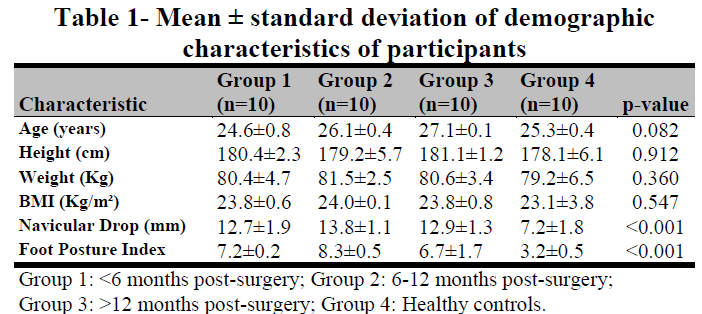
This quasi‑experimental pre‑test/post‑test study was conducted in a sports biomechanics laboratory. Sample size was calculated with G*Power 3.1 (α = 0.05, power = 0.8, effect size = 0.7), yielding a minimum of 10 participants per group. The study population comprised male patients with ACL reconstruction and pronated feet from Ardabil city, Iran. Forty men were recruited by convenience sampling and allocated by time since surgery into three groups: Group 1, <6 months post‑surgery (n=10); Group 2, 6–12 months (n=10); Group 3, >12 months (n=10). Ten healthy men without pronated feet or ACL injury formed a control group.
Inclusion criteria for patients were: age 18-45 years; unilateral ACL reconstruction with hamstring autograft; unilateral pronated foot (navicular drop >10 mm and Foot Posture Index >4); BMI 18.5-25 kg/m²; no pain in functional range of motion; ability to run without limitation; no history of lower‑limb fractures or deformities; no long‑term use of drugs affecting the musculoskeletal system; and willingness to participate. Exclusion criteria included other surgeries, other lower‑limb injuries, leg‑length discrepancy >5 mm, or withdrawal of consent. Healthy controls required absence of pronation and lower‑limb pathology.
GRF data were recorded with a Bertec force plate (USA) at 1000 Hz while participants walked barefoot at a self‑selected speed along a walkway. Three successful trials were collected for each of three conditions: no insole (barefoot), placebo insole (flat thin foam), and arch‑support insole (rigid polyurethane, 25 mm arch height, 15 mm posting). A treadmill fatigue protocol (Horizon Fitness, USA) began at 6 km/h, increasing by 1 km/h every 2 minutes until participants reported a Borg RPE ≥13 or reached 80% of maximum heart rate [29]. Speed was then held for >2 minutes before immediately repeating the walking trials.
GRF signals were filtered with a 4th‑order low‑pass Butterworth filter (cutoff 20 Hz). Frequency analysis used FFT in MATLAB R2016a. Variables analyzed were 99.5% Power Frequency (F99.5%), Median Frequency (Fmed), and Essential Harmonic Number (EHN) in vertical (Fz), mediolateral (Fy), and anteroposterior (Fx) directions. Statistical analyses were performed in SPSS‑23; normality was tested with Shapiro–Wilk. A two‑way repeated measures ANOVA (insole × time: pre vs. post fatigue) was applied within each group. Cohen’s d quantified effect size. Significance was set at p ≤ 0.05.

Results

Demographic data showed no significant differences between groups in age, height, weight, or BMI (p>0.05). As expected, navicular drop and foot posture index were significantly higher in patient groups compared to the healthy group (p<0.001) (Table 1).

Vertical Direction (Fz): The insole factor significantly increased the EHN from pre- to post-fatigue under the no-insole (p=0.044, d=0.42) and placebo insole (p=0.049, d=0.17) conditions. A significant insole × group interaction was observed for F99.5% under both placebo (p=0.012, d=0.97) and arch-support (p=0.030, d=0.82) conditions compared to no-insole. The arch-support insole also led to a significant decrease in F99.5% from pre- to post-fatigue (p=0.045, d=0.36).
Mediolateral Direction (Fy): The insole factor significantly increased EHN under placebo (p=0.048, d=0.75) and arch-support (p=0.005, d=0.62) conditions. F99.5% decreased significantly with arch-support insoles compared to no-insole (p=0.005, d=0.62). A significant interaction for Fmed was found under arch-support insoles (p=0.001, d=0.87). Furthermore, a significant reduction in F99.5% was observed only in Group 1 (<6 months post-op) when using arch-support insoles (p=0.049, d=0.11).
Anteroposterior Direction (Fx): The insole factor significantly increased EHN under no-insole (p=0.048, d=0.20) and arch-support insole (p=0.001, d=0.77) conditions. In contrast, it caused a significant decrease in F99.5% under the arch-support condition (p=0.001, d=0.77). A significant reduction in Fmed was also observed with arch-support insoles (p=0.013, d=0.37). The insole × group interaction for EHN was significant (p=0.005, d=0.45), and a significant decrease in F99.5% occurred only in Group 1 when using arch-support insoles (p=0.007, d=0.13).

Discussion and Conclusion

The results show that insoles, especially arch-support types, alter the frequency spectrum of GRFs in adults with ACL reconstruction and pronated feet, with effects most evident after fatigue. The increase in EHN in the vertical direction under no-insole and placebo conditions after fatigue indicates greater signal complexity and likely reflects increased demand on muscular control to maintain stability [24], possibly due to impaired shock absorption. In contrast, the stability of EHN with arch-support insoles post-fatigue suggests a protective effect in preserving movement-pattern integrity [25].
Arch-support insoles produced the largest reductions in high-frequency power (F99.5%) across all directions, particularly in the mediolateral and anteroposterior planes, implying a shift of spectral power toward lower frequencies. This shift is commonly associated with improved postural stability, fewer unnecessary body oscillations, and more efficient neuromuscular control [2, 3, 23]. The significant decreases in F99.5% and Fmed observed in Group 1 (<6 months post-surgery) indicate that the neuromusculoskeletal system is especially responsive to interventions during early rehabilitation, a period characterized by substantial neural adaptation and biomechanical recalibration, making external aids like insoles potentially more impactful [26, 36].
Mechanistically, arch-support insoles likely enhance dynamic stability by improving proprioceptive feedback, optimizing plantar pressure distribution, and modulating muscle activity around the ankle and knee [13, 34]. These changes can produce smoother movement control, reduced joint stiffness, and potentially lower re-injury risk [35]. The placebo insoles produced modest effects as well, suggesting that even non-specific tactile input can alter gait, though to a lesser degree than structured arch suppor.
In summary, arch-support insoles appear to improve dynamic stability in individuals with ACL reconstruction and pronated feet, with the greatest benefit during the early postoperative stage. These findings support the inclusion of foot biomechanics assessment and appropriate orthotic intervention in comprehensive rehabilitation programs for ACL-reconstructed patients, particularly those with concomitant foot pronation.

Ethical Considerations

This study was approved by the Ethics Committee of Mohaghegh Ardabili University (Code: IR.UMA.REC.1404.019) and was registered in the Iranian Clinical Trial Registry (code: IRCT20220129053865N2). Written informed consent was obtained from all participants. The study was conducted in accordance with the principles of the Helsinki Declaration.

Funding

There is no funding support.

Authors’ Contribution

All authors contributed equally to the conceptualization and writing of the article. Each author reviewed and approved the final manuscript, agreeing on all aspects of the work.

Conflict of Interest

Authors declared no conflict of interest.

Acknowledgments

The authors sincerely thank all participants who volunteered for this study. We also acknowledge the support of the biomechanics laboratory staff.
 
References
1. Lee IM, Buchner DM. The importance of walking to public health. Medicine and Science in Sports and Exercise. 2008;40(7 Suppl):S512-518. doi:10.1249/MSS.0b013e31817c65d0
2. Jaafarnejad A, Amirzade N, Heseinpour A, Siahkouhian M, Mokhtari Malek Abadi A. Evaluation of frequency spectrum of ground reaction force during walking on sand and flat surface in individuals with pronated foot. The Scientific Journal of Rehabilitation Medicine. 2020;9(3):93-101. [Persian] doi:10.22037/jrm.2019.112643.2230
3. Piri E, Jafarnezhadgero A, Stålman A, Alihosseini S, Panahighaffarkandi Y. Comparison of the ground reaction force frequency spectrum during walking with and without anti-pronation insoles in individuals with pronated feet. Journal of Sport Biomechanics. 2025;11(1):20-33. [Persian] doi:10.61186/JSportBiomech.11.1.20
4. Di Stasi SL, Snyder-Mackler L. The effects of neuromuscular training on the gait patterns of ACL-deficient men and women. Clinical Biomechanics. 2012;27(4):360-365. doi:10.1016/j.clinbiomech.2011.10.008
5. Razeghi M, Batt ME. Foot type classification: A critical review of current methods. Gait & Posture. 2002;15(3):282-291. doi:10.1016/s0966-6362(01)00151-5
6. Castellanos Dolk D, Hedevik H, Stigson H, Wretenberg P, Kvist J, Stålman A. Nationwide incidence of anterior cruciate ligament reconstruction in higher-level athletes in Sweden: a cohort study from the Swedish National Knee Ligament Registry linked to six sports organisations. British Journal of Sports Medicine. 2025;59(7):470-479. doi:10.1136/bjsports-2024-108343
7. Koreili Z, Fatahi A, Azarbaijany MA, Sharifnezhad A. Comparison of static balance performance and plantar selected parameters of dominant and non-dominant leg in active adolescent’s female with ankle pronation. The Scientific Journal of Rehabilitation Medicine. 2023;12(2):306-319. [Persian] doi:10.32598/sjrm.12.2.7
8. Piri E, Jafarnezhadgero A, Stålman A. Advantages and disadvantages of different surgical grafts in anterior cruciate ligament injuries: A letter to the editor. Journal of Sport Biomechanics. 2024;10(3):254-260. [Persian] doi:10.61186/JSportBiomech.10.3.254
9. Xiao J, Feng C, Chu J, Zhao W, Zhang B, Yuan X. Proximal core strengthening training for anterior cruciate ligament injury prevention with biomechanical improvements in knee/hip kinematics and strength gains: a systematic review and meta-analysis of low-certainty evidence. BMJ Open. 2025;15(9):e093009. doi:10.1136/bmjopen-2024-093009
10. Xiao Y, Yang C, Xiang J, Li H, Chen B. Influence of anteromedial and central anterior cruciate ligament reconstruction on patellofemoral joint biomechanics during walking and running: A musculoskeletal modelling study. Acta of Bioengineering and Biomechanics. 2025;27(2):119-131. doi:10.37190/abb/206980
11. McPoil TG, Cornwall MW. The effect of foot orthoses on transverse tibial rotation during walking. Journal of the American Podiatric Medical Association. 2000;90(1):2-11. doi:10.7547/87507315-90-1-2
12. Cavanagh PR, Rodgers MM. The arch index: A useful measure from footprints. Journal of Biomechanics. 1987;20(5):547-551. doi:10.1016/0021-9290(87)90255-7
13. Nawoczenski DA, Ludewig PM. Electromyographic effects of foot orthotics on selected lower extremity muscles during running. Archives of Physical Medicine and Rehabilitation. 1999;80(5):540-544. doi:10.1016/s0003-9993(99)90196-x
14. Farahpour N, Jafarnezhad A, Damavandi M, Bakhtiari A, Allard P. Gait ground reaction force characteristics of low back pain patients with pronated foot and able-bodied individuals with and without foot pronation. Journal of Biomechanics. 2016;49(9):1705-1710. doi:10.1016/j.jbiomech.2016.03.056
15. Hsieh RL, Peng HL, Lee WC. Short-term effects of customized arch support insoles on symptomatic flexible flatfoot in children: A randomized controlled trial. Medicine 2018;97(20):e10655. doi:10.1097/md.0000000000010655
16. Jafarnezhadgero A, Alavi Mehr SM, Majlesi M. Effect of long term use of arch support foot orthoses on walking ground reaction force asymmetry index in children with flexible flat feet: A cohort study. Medical Journal of Tabriz University of Medical Sciences. 2019;41(4):31-39. [Persian] doi:10.34172/mj.2019.043
17. Hamill J, McNiven SL. Reliability of selected ground reaction force parameters during walking. Human Movement Science. 1990;9(2):117-131. doi:10.1016/0167-9457(90)90023-7
18. Crowe A, Schiereck P, Boer RWd, Keessen W. Characterization of human gait by means of body center of mass oscillations derived from ground reaction forces. IEEE Transactions on Biomedical Engineering. 1995;42(3):293-303. doi:10.1109/10.364516
19. Giakas G, Baltzopoulos V. Optimal digital filtering requires a different cut-off frequency strategy for the determination of the higher derivatives. Journal of Biomechanics. 1997;30(8):851-855. doi:10.1016/s0021-9290(97)00043-2
20. Giakas G, Baltzopoulos V, Dangerfield PH, Dorgan JC, Dalmira S. Comparison of gait patterns between healthy and scoliotic patients using time and frequency domain analysis of ground reaction forces. Spine 1996;21(19):2235-2242. doi:10.1097/00007632-199610010-00011
21. Stergiou N, Giakas G, Byrne JB, Pomeroy V. Frequency domain characteristics of ground reaction forces during walking of young and elderly females. Clinical Biomechanics. 2002;17(8):615-617. doi:10.1016/s0268-0033(02)00072-4
22. White R, Agouris I, Selbie RD, Kirkpatrick M. The variability of force platform data in normal and cerebral palsy gait. Clinical Biomechanics. 1999;14(3):185-192. doi:10.1016/s0268-0033(99)80003-5
23. Wurdeman SR, Huisinga JM, Filipi M, Stergiou N. Multiple sclerosis affects the frequency content in the vertical ground reaction forces during walking. Clinical Biomechanics 2011;26(2):207-212. doi:10.1016/j.clinbiomech.2010.09.021
24. Mohammadi V, Letafatkar A, Sadeghi H, Jafarnezhadgero A, Hilfiker R. The effect of motor control training on kinetics variables of patients with non-specific low back pain and movement control impairment: Prospective observational study. Journal of Bodywork and Movement Therapies. 2017;21(4):1009-1016. doi:10.1016/j.jbmt.2016.12.009
25. Telfer S, Abbott M, Steultjens MPM, Woodburn J. Dose–response effects of customised foot orthoses on lower limb kinematics and kinetics in pronated foot type. Journal of Biomechanics. 2013;46(9):1489-1495. doi:10.1016/j.jbiomech.2013.03.036
26. McGrath D, Judkins TN, Pipinos, II, Johanning JM, Myers SA. Peripheral arterial disease affects the frequency response of ground reaction forces during walking. Clinical Biomechanics. 2012;27(10):1058-1063. doi:10.1016/j.clinbiomech.2012.08.004
27. Ginn K, Halaki M. Normalization of EMG Signals: To Normalize or Not to Normalize and What to Normalize to? In: Naik GR, ed. Computational Intelligence in Electromyography Analysis - A Perspective on Current Applications and Future Challenges. London: IntechOpen; 2012. doi:10.5772/49957
28. Schneider E, Chao EY. Fourier analysis of ground reaction forces in normals and patients with knee joint disease. Journal of Biomechanics. 1983;16(8):591-601. doi:10.1016/0021-9290(83)90109-4
29. Jafarnezhadgero AA, Noroozi Z, Piri E. Evaluating the frequency of the electrical activity of lower limb muscles before and after fatigue during running in individuals with a history of coronavirus disease 2019 compared to healthy individuals. Journal of Gorgan University of Medical Sciences. 2024;26(1):56-65. [Persian] doi:10.61882/goums.26.1.56
30. Jeon HG, Lee SY, Park SE, Ha S. Ankle instability patients exhibit altered muscle activation of lower extremity and ground reaction force during landing: A systematic review and meta-analysis. Journal of Sports Science & Medicine. 2021;20(2):373-390. doi:10.52082/jssm.2021.373
31. Piri E, Farzizade R, Barghamadi M. The effect of exercises in water and thera-band on the frequency spectrum of ground reaction forces in people with pronate foot during walking: A clinical trial. Studies in Medical Sciences. 2022;33(8):621-633. [Persian] doi:10.52547/umj.33.8.621
32. Pietrosimone B, Seeley MK, Johnston C, Pfeiffer SJ, Spang JT, Blackburn JT. Walking ground reaction force Post-ACL reconstruction: Analysis of time and symptoms. Medicine and Science in Sports and Exercise. 2019;51(2):246-254. doi:10.1249/mss.0000000000001776
33. Costa M, Priplata AA, Lipsitz LA, Wu Z, Huang NE, Goldberger AL, Peng CK. Noise and poise: Enhancement of postural complexity in the elderly with a stochastic-resonance-based therapy. Europhysics Letters. 2007;77:68008. doi:10.1209/0295-5075/77/68008
34. Parsa R, Jafarnezhadgero A, Piri E. The effect of using double-density soles on the loading rate, impulse, free moment, and ground reaction forces in adolescent volleyball players with pronated feet during running and landing. Iranian Journal of Rehabilitation Research in Nursing. 2025;11(3):20-30. [Persian] doi:10.22034/ijrn.11.3.20
35. Galvão AF, Lemos T, Martins CP, Horsczaruk CHR, Oliveira LAS, Ferreira AS. Body sway and movement strategies for control of postural stability in people with spinocerebellar ataxia type 3: A cross-sectional study. Clinical biomechanics (Bristol, Avon). 2022;97:105711. doi:10.1016/j.clinbiomech.2022.105711
36. Jafarnezhadgero A, Sorkhe E, Meamarbashi A. Efficacy of motion control shoes for reducing the frequency response of ground reaction forces in fatigued runners. Journal of Advanced Sport Technology. 2019;3(1):8-21.
Send email to the article author

Add your comments about this article
Your username or Email:

CAPTCHA

Ethics code: IR.UMA.REC.1404.019
Clinical trials code: IRCT20220129053865N2


XML   Persian Abstract   Print


Download citation:
BibTeX | RIS | EndNote | Medlars | ProCite | Reference Manager | RefWorks
Send citation to:

Piri E, Jafarnezhadgero A, Dehghani M, Enteshari-Moghaddam A. The effect of arch-support insoles on the frequency spectrum of ground reaction forces during waking in adults with anterior cruciate ligament reconstruction (ACL) reconstruction and pronated feet. EBNESINA 2025; 27 (3) :25-41
URL: http://ebnesina.ajaums.ac.ir/article-1-1417-en.html


Rights and permissions
Creative Commons License This work is licensed under a Creative Commons Attribution-NonCommercial 4.0 International License.
Volume 27, Issue 3 (10-2025) Back to browse issues page
ابن سینا EBNESINA
Persian site map - English site map - Created in 0.21 seconds with 39 queries by YEKTAWEB 4774